Showing posts with label lessons learned. Show all posts

Wednesday, May 5, 2010

Theme 2: Meyrowitz and the evolution of technology


Joshua Meyrowitz discusses the separation of social space from physical place with some of his theories about electronic media’s influence on society. What this means is that before electronic media, there existed a time when a physical place was what you needed in order to socialize. There was no Internet or cyber, instantaneous communication, and even once there was, it was never to the overly specific degree that it is now. To communicate, you did so through actual physical channels such as roads and railroads. Things then moved onto telegraphs, telephones, and radios. Now communication is simply a click or a touch away. There has been a creation of something known as “social space,” where interaction is no longer physical. For a person to experience an event, it does not need to be “live” anymore.

The same can be said for getting to know a person. There are now non-visible networks online that can essentially choose your friends for you based on common interests, and even allow you to stay in close contact with them electronically. New kinds of relationships are built that way. When unifying technology first emerged like with the creation of the radio, the listener was an active participant and though miles apart from the others listening, they still had a common bond. Mary Dyck, as described in “The Radio Diary of Mary Dyck” grew attached to her radio and it began to function as both a companion and connector to the outside world.

As time went on, this interconnectivity with the radio flourished even more for the general public with emerging new media and different
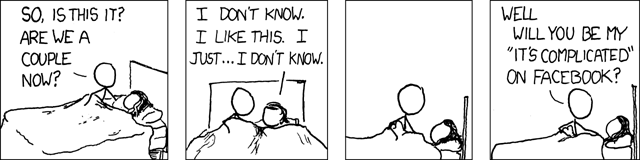
types of social networks. This is when para-social relationships were formed, meaning, relationships that are mediated but still resemble face-to-face interaction because of the medium through which they travel. The viewers begin to believe that they “know” the other people on the end of the information spectrum, similar to the way an audience might feel they know the character of a movie so well.

Full cartoon here

To thank for this, we have examples of ambient awareness such as Twitter and Facebook, where your friends and followers are your personal audience. Because of Twitter’s streaming of meaningless updates and Facebook’s perfectly engineered stalking mechanisms, they are able to pick up on the feelings, habits, and mood changes of all of their friends without exerting the physical energy. This makes it easier for them to develop relationships with the person because, in a sense, Facebook is doing it for them. The same can be applied to instant messaging – it’s automatic responses, which can further relationships and paint a picture of the person you’re speaking to on the other end. Now that Facebook has found a way to combine IMing with their site, the para-social interactions are enhanced and showing how much socializing is evolving.

Wednesday, April 21, 2010

Text without Context Response

1. This society has become accustomed to instantaneous answers which is shown with the growing popularity of Twitter and YouTube. These fairly new media bring in audiences because they are more willing to cut to the chase with their content. People now prefer to tune into information that is immediately available, rather than something that is analyzed, and carefully thought out. For example, instead of reading an entire news story a person is now more likely to look for a sound clip, sound bite, or short blurb. This makes it harder for individuals to develop an opinion on their own. When watching a play or movie, people will text or tweet, and they won’t give the show a chance to win them over. This pre-judging then enters the cyber world for others to adopt as their own opinions. Even scholars are guilty of falling prey to this simplified way of researching. Instead of sifting through stacks of literature, they might only search online.


2. The term “cyberkalnization” refers to the division in the World Wide Web into subgroups. People now can subscribe to only receive the specialized news that they like to hear about, and exclude everything else from getting to them. With automatically updated feeds, people are avoiding having any serendipitous encounters that might infiltrate their thoughts on what they are already use to. I am also somewhat guilty of this myself. I follow only those with opinions that I already have myself on Twitter. I know personally of people who receive Yahoo news feeds that focus only on entertainment news or sports news because they aren’t concerned with any other news. In a way, this specifically engineered filtering is beneficial for you if you only want what you’re use to. It bypasses all the extra news so that you don’t have to sift through it yourself.


3. These trends might take away from the audience that usually tuned into authors, composers, and filmmakers because if people can get a concise yet entertaining piece of their work, they won’t be inclined to look for more. The re-produced work, to them, is just as good as the original work and possibly better because you can get it in smaller portions and have it include the parts you like. These creators of original works will have their thoughts recycled, and even though it’ll be works without context, the truth is that people aren’t craving context anymore.


4. Appropriation art means giving credit to any part of a piece that was inspired by something else. This is a way to copyright, in some ways, an artist’s idea and to make sure that credit is given to a creator. The author argues that everything, especially words are owned by “owned by our entire culture,” and with a little revision and slight credit, it is okay to duplicate this. As Journalism major, I partially agree with this because I know I would not want my ideas to be copied in any way, unless full credit was being given to me. However, I think that when it comes to other forms of art, outside of written works, it gets more difficult to give credit.


5.
The idea of an audience is described as archaic because we live in a time when the audience’s opinion doesn’t seem to matter. In a 2005 issue of Wired magazine the information we are given is described as “an endless, recombinant, and fundamentally social process generated by countless hours of creative product.” What the audience is receiving is a “mash up” of the same ideas from years worth of fandom that are just repackaged. Our online media is a culture of reaction from other thoughts without any new actions of our own. Most online responses are driven by the sphere of old media.

Monday, February 15, 2010

Blame it on the cold

One more day till I'm free!

& surprisingly, I feel great (dun na na na na na na na). In all seriousness though, I'm not missing Twitter all that much. It's like I'm going back to life before Twitter, and I'm starting to remember how I use to find out what everyone was doing: by asking.

In the beginning I wanted to make a big deal about this, but not tweeting really isn't a big deal at all. I'm glad that I was able to tear myself away from this little bit of technology. It taught me that I have self-control, and that even if I can't deny how much other forms of media have a hold on my life, at least I could stop doing this one thing.

I just told my friends about my little experiment and they're all saying they miss my tweets and that they couldn't believe that I - the person who got them all hooked on Twitter, Twitter's biggest fan and poster child - was able to stop for even a few days. Um, I'm sorry? -_-

Aside from Twitter deprivation, I've been sick and that might have added to me not feeling the need to tweet my misery. This is most likely from yesterday in the city, since I decided to look cute I didn't dress for the weather. I did, however, see Avatar in 3D (Finally! & it's my new favorite movie of 2010. I cried. Again) and get these delicious, heaven-on-earth-tastin' cupcakes. . .


And consider investing in this highly unnecessary, but cute gadget. .

But enough about me. Hopefully everyone had a stellar v-day and isn't feeling too media starved.


Friday, February 12, 2010

Welcome to the Real World


From now (Friday, February 12th) until Sunday, the 14th I'll be going on a Twitter Detox. Trust me, it's not of my own influencing but perhaps it'll be for the best? Last night (my last official night of tweeting) I decided to talk about any and everything happening to my friends. I didn't inform my followers that I'd be gone for a few days, but despite my obvious reliance on the social networking tool, I didn't think it was all that necessary. Or maybe I'm still in denial?

Either way, wish me luck as I endure through what I'm hoping is a painless detoxification. I'll have to resort to texting people once again and sadly, when I'm wondering what everyone else is doing I'll just have to use my imagination. No retweeting clever comments, no immediate feedback or advice on an awkward situation. Nada.

I know it's only a few days but that doesn't make the process any easier *pouts* Wish me luck.